PDP Punjab success story
Both systems in one PDF: the program, what we took over, what we re-engineered and how the systems run today. Ready to attach to a tender or evaluation file.
- English
- 4 pages · 1.5 MB

Monitoring, payment and field systems built to stand up to audit
NexGenix is a government software development company in Pakistan. We build, take over and run the systems public programs depend on: development project monitoring dashboards, contract and IPC payment systems, and offline field apps. Since July 2026 we have re-engineered and operated two live systems for the Program Management Unit (PMU) of the Punjab Development Program, on the Government of Punjab’s own server.
Government software is held to a different standard. Every figure has to be defensible in a review, every approval traceable to a named desk, and the same system has to work for an officer on a phone at a site with no signal and for a Secretary reading a provincial summary that afternoon. We design for that standard from the first screen.
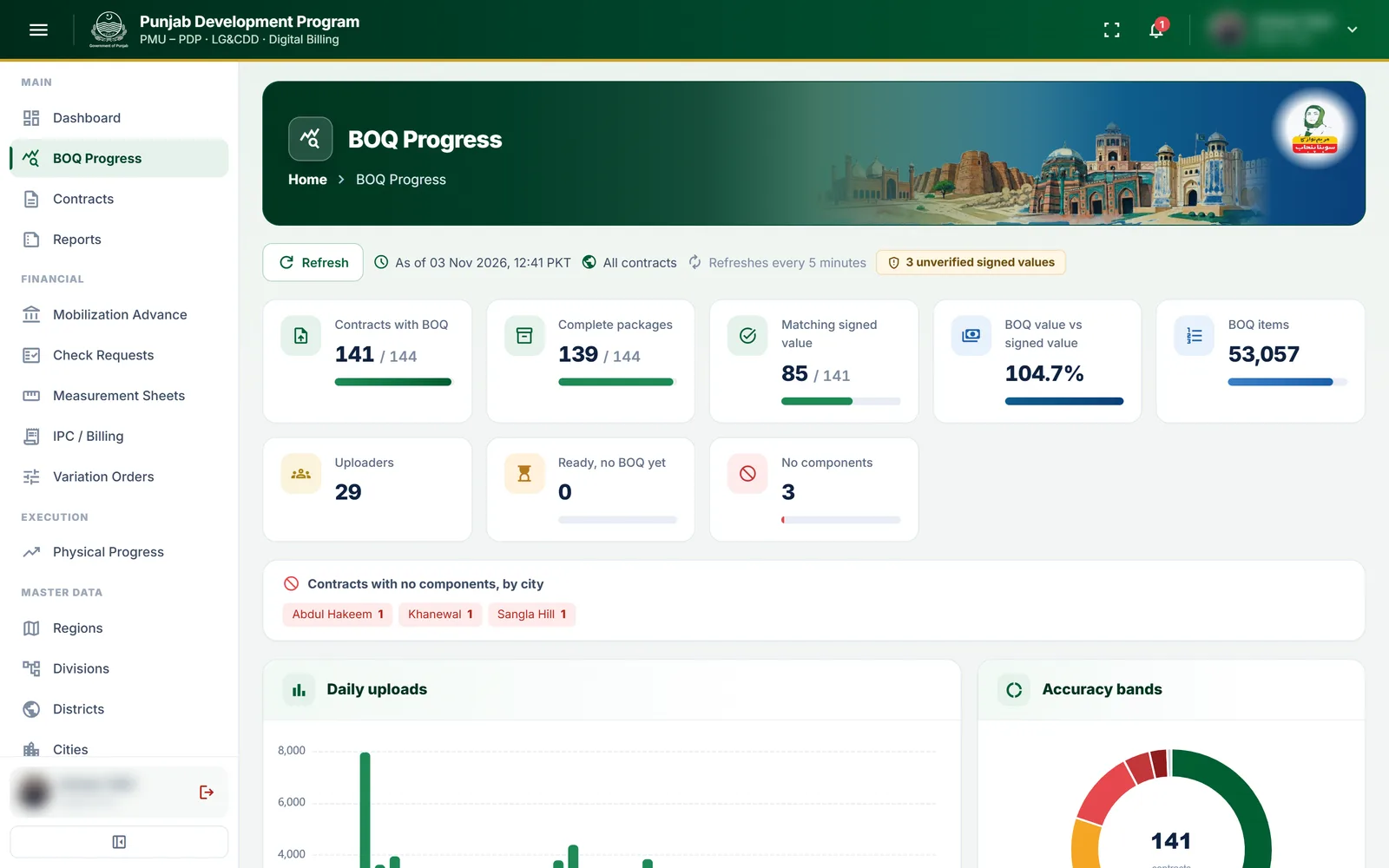
Our proof is live. Since July 2026 NexGenix has re-engineered and operated two Government of Punjab systems for the PMU of the Punjab Development Program, LG&CD Department: the PDP Executive Monitoring Dashboard, which tracks works in 52 cities with weighted, photo-backed progress, and PMIS, the contract and payment system that routes every interim payment certificate through 11 approval desks to the province’s Financial Management System. Both were originally developed by Technology Hive; we migrated them to the Government’s own server and have run them since.
That work covers the parts of e-governance that are easy to underestimate: taking over a live system without stopping it, multi-level roles and scoped visibility, approval routes a department can change itself, audit trails that can be verified, integration with provincial finance systems, and field apps that work offline.
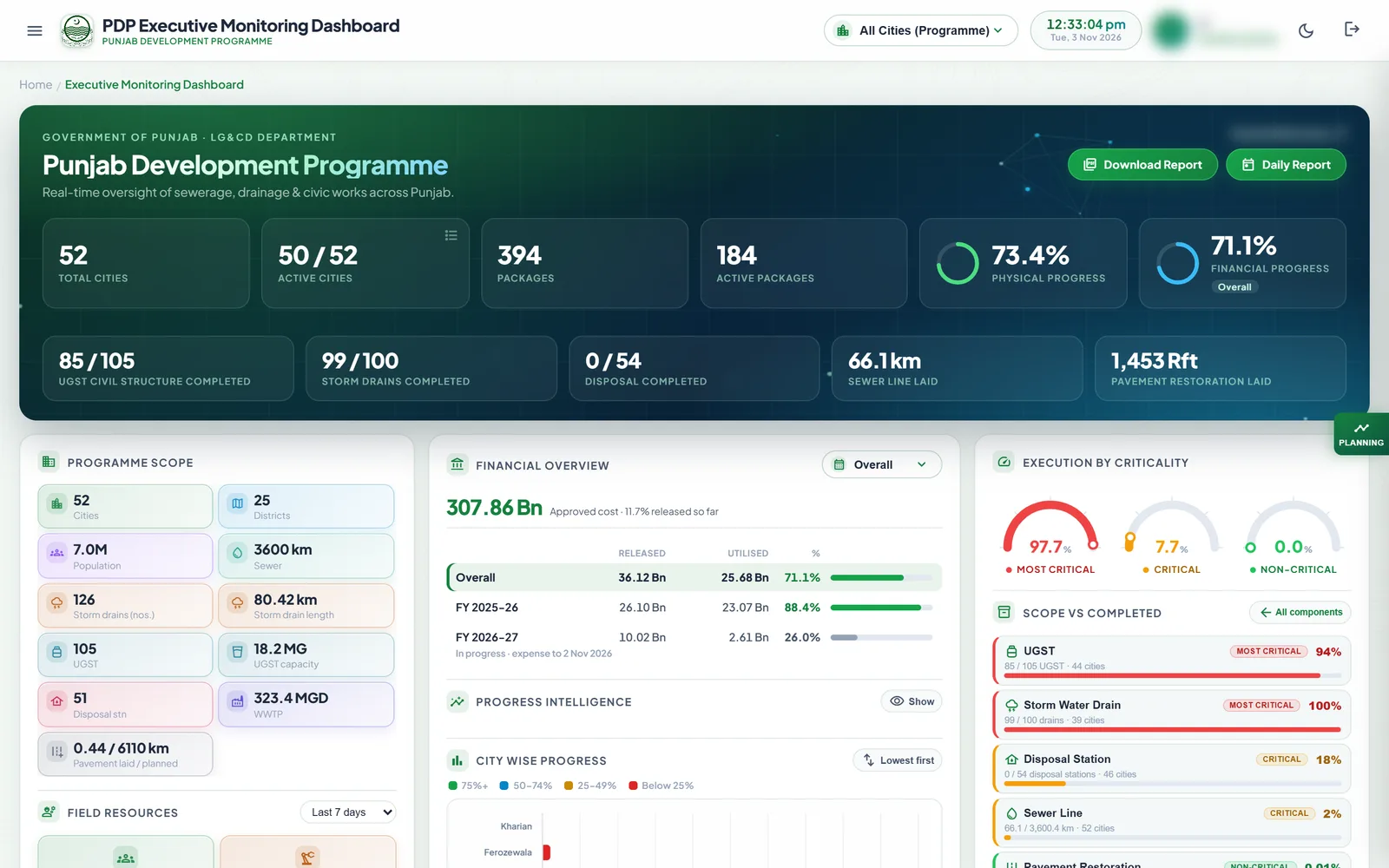
Read how we took over, migrated and re-engineered the PDP Executive Monitoring Dashboard, a development project monitoring system for 52 cities, and PMIS, the public works contract and IPC payment system linked to the province’s Financial Management System. Both case studies cover the problem, the engineering and how the systems run today.
Both systems in one PDF: the program, what we took over, what we re-engineered and how the systems run today. Ready to attach to a tender or evaluation file.
A Program Management Unit runs on delegation: who may enter a figure, who may approve it, who may only see it. We start by mapping that delegation (desks, roles, geography and the documents each desk signs) and build the system around it, rather than asking the department to adopt a vendor’s idea of a workflow.
A typical engagement runs in five stages: an assessment of your current process and terms of reference, a pilot in one district or module, a phased rollout with training, a handover or an operating agreement, and a support retainer. You approve each stage before the next one begins.
Work then moves in small approved releases. Each change is one item on a register the department can read; it goes live with a backup taken first and is checked on the live system afterwards. PMIS has received 45+ live releases this way since July 2026.
Many departments already own a system that works but no longer fits: the original vendor has moved on, the server sits outside government control, or the program has changed around it. Taking such a system over is specialist work. We audit the code and data, document how each figure is produced, and only then plan the move.
For the Punjab Development Program we moved both systems, the monitoring dashboard with its full photo archive and the payment portal, onto the Department’s own server in July 2026. Field reporting on the dashboard dipped for a single day, and older field-app versions redirected themselves through their own update prompt, so no officer had to reinstall.
Takeover is also where much of the early value lies. On the PDP Dashboard we released 75 improvements in the first month after the move; on PMIS the first release after migration rebuilt geography, access rights and role mapping, and passed 221 QA checks with zero failures.
Public money and public data need a record that can be checked. Our payment work uses a four-layer audit trail: decisions written with the change they record, a log of every request, database-level before-and-after values, and a nightly SHA-256 hash chain that exposes any edited entry. Accounts with history are disabled, never deleted, and approvals are tied to the post a person held on that date.
Data stays where the department decides. We deploy on government servers, including locked-down ones with no open internet access, keep passwords hashed, and check access by role and geography on the server for every request.
A payment system that stops at approval leaves finance to re-key every bill. PMIS sends each approved interim payment certificate to the province’s Financial Management System (FMS) on the Program Director’s final approval, automatically since 21 October 2026.
We build these links defensively: checks before sending, retries only for network failures and never for a refusal, duplicates recognised and recorded, the bill locked once accepted, and every request and response stored for audit. Read-only feeds for other authorised government systems follow the same approach, with keys that can be limited to specific cities or units.
Public works happen where the signal is weakest. Our field apps queue every filing, photo and return on the phone and sync later, with a unique reference on each so a retry never files twice. The server, not the phone, burns an evidence banner into every photo filed from the app, with the officer, location, time and a verification code.
Where progress can be measured, we measure it: officers draw the executed sewer, drain or pavement alignment over the approved design, and the length comes from the line. Daily plans, safety checklists, “no activity today” declarations and minimum-version checks keep the field record complete and current.
Public buyers evaluate on paper as much as on demonstrations. We provide the documents an evaluation committee or consultant expects: a capability statement, system documentation and user manuals, architecture and data-flow descriptions, role and permission matrices, QA results and deployment plans. Our PDP Punjab success story is available as a PDF to attach to your file.
NexGenix (Private) Limited is SECP registered, FBR compliant and PSEB certified, and we will sign a non-disclosure agreement before reviewing any of your systems or data.
Some departments want us to run the system; others want to run it themselves. We support both. For the PDP systems we operate the platforms day to day under a release register the PMU can follow. For a handover we deliver the source code, deployment runbooks, user manuals for every role and training for officers and IT staff, then stay on a maintenance retainer for as long as you need cover.
Shared operation works too. In October 2026 we added an IT Wing role to the PDP Dashboard, so the Department’s own IT staff hold every PMU administration permission except user management and run day-to-day administration themselves.
Everything we handle when you work with us on this.
Development project monitoring systems with weighted progress, GIS maps, S-curves and one-click executive briefs generated from live data.
Bills of Quantities, measured billing, server-computed deductions and multi-desk approval routes, with every decision on the record.
Android apps for officers on site: offline queues that never file twice, GPS-drawn alignments, photo evidence and safety checklists.
Audit, documentation and migration of an existing government system onto your own servers, without a break in daily operations.
Links to provincial financial management systems and read-only data feeds for authorised government systems, with every exchange logged.
Release registers, backups before every change, user manuals, training and maintenance retainers for systems that cannot stop.
Other platforms our team builds, runs and supports.
Yes. Since July 2026 NexGenix has re-engineered and operated two live systems for the Program Management Unit (PMU) of the Punjab Development Program, LG&CD Department, Government of Punjab: a development project monitoring dashboard and a contract and payment management system, both on the Government’s own server.
Launch is the start, not the finish. Our retainers keep your systems secure, fast and evolving — with a dedicated engineering partner who already knows your codebase.
Tell us what you're building and we'll tell you how we can help — starting with a free consultation.