Skip to content
Business Systems & Platforms

Custom Medical Billing Software Development

Revenue cycle software built around your workflow, and owned by you

NexGenix builds custom medical billing software for US billing companies, practices and MSOs, and for clinics, hospitals and TPAs in the Gulf. Each system is scoped to your workflow, connected to your clearinghouse and EHRs, and owned by you.

Overview

NexGenix offers medical billing software development as an on-demand service. We design and build revenue cycle management (RCM) software around how your team already works: your specialties, payers, clearinghouse, EHRs and the reports your clients expect. There is no ready-made product to bend your process around: we build the modules you need first and add more as you grow. We focus on small and mid-size US medical billing companies serving 5 to 200 client practices, but the approach also fits in-house billing teams, MSOs, RCM start-ups and Gulf providers.

Why custom? Most billing platforms are rented, not owned. Vendors charge a percentage of collections, a fee per provider or a fee per claim, so your software bill grows with every client you sign. With a custom build you own the source code and the data, pay no percentage of collections to a software vendor, export anything at any time, and change the system when your business changes. Custom is not right for everyone, and further down we explain when off-the-shelf is the better choice.

Before scoping this service, we reviewed 20 US medical billing platforms. The basics are covered: 16 or more offer eligibility checks, claim scrubbing, ERA auto-posting, denial queues and online payments. The gaps sit elsewhere: AI aimed at doctors rather than billers, multi-client tools with little intelligence behind them, lock-in to a single EHR, and pricing that is hard to see. That is where a custom system pays its way, provided the engineering underneath is right: X12 EDI, payer rules, audit trails and a multi-client design that keeps each practice’s data separate.

Custom Medical Billing Software Development

Where today’s billing platforms fall short

Our review covered all-in-one EHR suites, specialty suites, billing-first practice-management tools and AI billing layers. Here is what we found, and what we build in response.

The gap

AI built for doctors, not billers

11 of the 20 platforms have a solid AI scribe for clinical notes, but 9 of the 20 score 0 or 1 out of 3 on predicting denials.

What we build

Denial-risk scoring on every claim before it goes out, learned from your own 835 remittances, with the reasons shown and a biller deciding what to fix.

The gap

Multi-client tools or AI, rarely both

9 of the 20 offer full multi-client tools, yet none of those 9 reaches 14 out of 21 on AI depth. Billing-first tools, common at billing companies, average about 1 out of 21.

What we build

One command center across all your client practices, with AI-assisted work queues, per-client dashboards and strict data separation between practices.

The gap

Tied to one EHR

9 of the 20 platforms don’t work with any EHR except their own, a real problem when your client practices use different EHRs.

What we build

An integration hub that pulls encounters and charges from each practice’s EHR, whichever one it runs, so your team stops re-keying them.

The gap

Pricing you can’t see, fees that grow

11 of the 20 hide at least part of their pricing. Common models are a percentage of collections (about 4–8%), a fee per provider per month, or a fee per claim.

What we build

Software you own outright: no percentage of collections to a software vendor, and hosting and clearinghouse costs you can see.

The gap

AI that doesn’t explain itself

Across the 20 platforms, AI rarely shows its reasoning: a suggested code is seldom linked to the note text that supports it.

What we build

Every suggested CPT or ICD-10 code links to the sentence it came from. A coder approves or edits it, and the decision goes into the audit trail.

The gap

Useful features that are still rare

Insurance-card OCR, automatic discovery of secondary insurance and import from any EHR are offered by only a few of the 20.

What we build

Card OCR at registration, eligibility checks across likely payers to find coverage the patient didn’t mention, and an import for each EHR your practices use.

Source: NexGenix internal review of 20 US medical billing platforms, November 2026, based on public vendor information, press coverage and review sites. Scores use our own rubric (AI depth out of 21, denial prediction out of 3). All figures are our estimates and have not been verified by the vendors.

The full revenue cycle, module by module

A complete RCM system has 13 modules in four stages. Start with the ones that matter most to you and add the rest in later releases.

  1. Front end

    Clean data before the visit: real-time 270/271 eligibility checks, 278 prior authorizations, insurance-card capture and demographics imported from the EHR.

    • 1Insurance verification & authorization
    • 2Patient registration
    • 3Patient encounter & EHR import
  2. Mid cycle

    Codes and charges that pass payer edits: CPT, ICD-10-CM and HCPCS coding with NCCI and MUE checks, then 837P/837I claims with 999 and 277CA acknowledgments.

    • 4CPT & ICD-10 coding
    • 5Charge entry
    • 6Claim submission
  3. Back end

    Getting paid: 835 ERA auto-posting, 276/277 claim status, denial queues driven by CARC and RARC codes, appeals, patient statements and online payments.

    • 7Payment posting
    • 8Patient statements & inquiries
    • 9A/R follow-up & appeals
    • 10Denial management
  4. Analytics & admin

    Dashboards per client and per payer, KPI tracking against your targets, and provider credentialing and enrollment with expiry alerts.

    • 11Reporting
    • 12Performance improvement
    • 13Credentialing & provider enrollment

Under every module

  • Multi-client command center with per-practice data separation
  • Integration hub for EHRs, clearinghouse, payments and mail
  • AI engine with human approval and a full audit trail
  • Security and compliance controls built to HIPAA requirements
  • Admin and master data: payers, fee schedules and contracts
  • Invoicing for your billing company’s own client fees

Our closest proof: payment workflows and multi-client scale

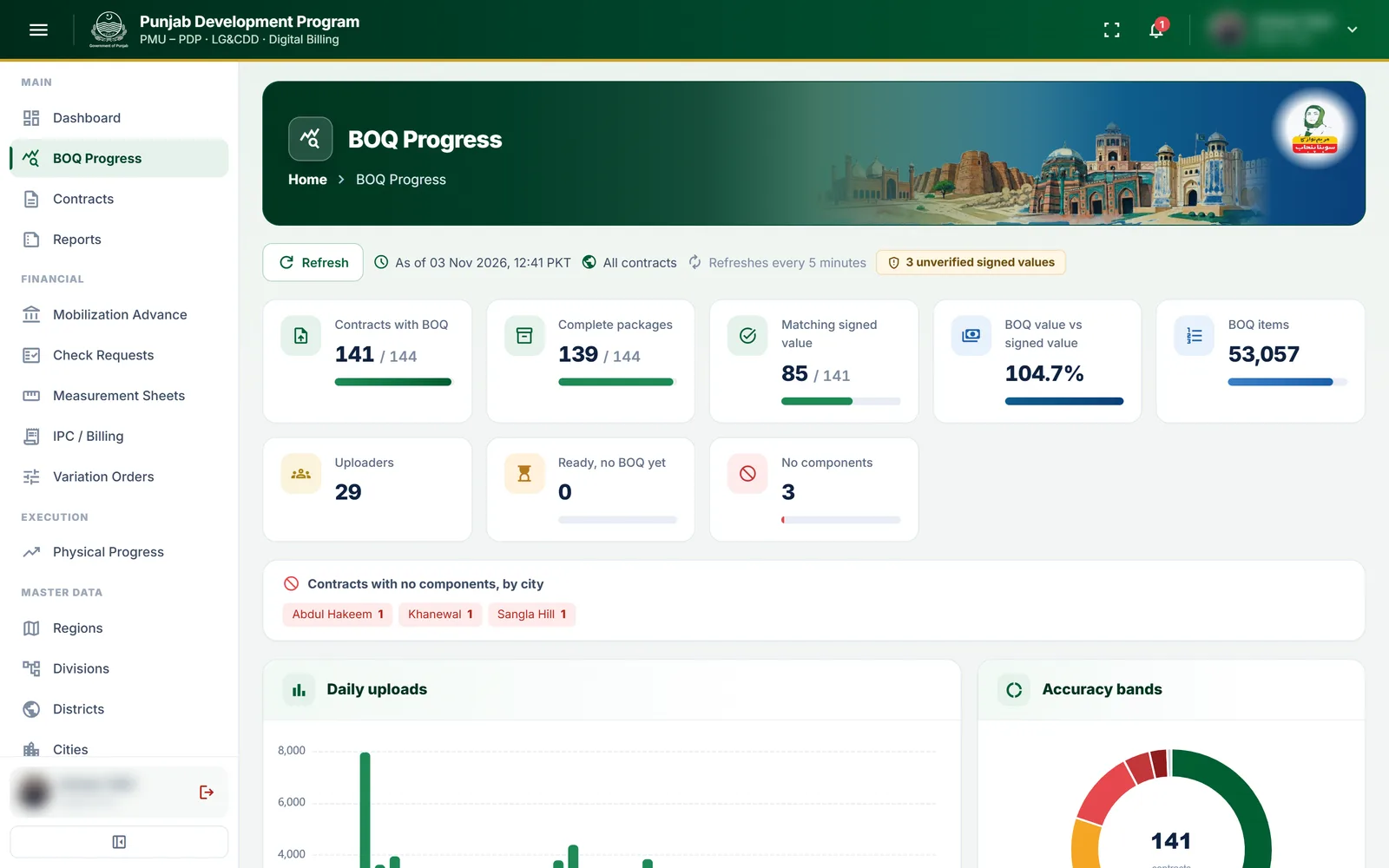
Two systems show the engineering this work needs. Since July 2026 NexGenix has re-engineered and operated PMIS, the Punjab Development Program’s contract and payment system, after migrating it to the Government of Punjab’s own server; the original platform was developed by Technology Hive. Each contractor payment follows an 11-step approval route, nine deduction types are computed on the server, and approved payments reach the province’s Financial Management System over a live link: the same shape as claims, adjustments and payment posting. Alpha Track, the enterprise GPS fleet management platform we engineered, serves multiple fleet operators from a single multi-tenant Laravel deployment, with 287 production tables, 500,000+ lines of code and 200+ GPS device protocols, which is the design a billing company with many practices and payers needs. Neither is a healthcare project; they are the closest engineering we can show you.

How an on-demand build works

Every RCM software development project we run follows five steps: discovery, specification, MVP, pilot and rollout. After a free discovery call, we map your workflow in detail: specialties, payers, clearinghouse, EHRs, who touches each claim and what your clients expect to see. You get a written specification and a phased estimate, and you approve each phase before the next one starts.

The first release is an MVP built around your highest-volume path, often eligibility, charge entry, 837 submission and 835 posting for one specialty, running on test data. Once a BAA is signed, a pilot runs with one or two client practices and real claims, measured against typical industry goals: first-pass rate 95%+, denial rate below 5%, days in A/R under 35, A/R over 90 days under 15%, net collection 95%+ and charge lag under 3 days. Rollout then goes practice by practice, with training for your team and the old system in parallel until the numbers match.

Build or buy: when custom makes sense

Custom makes sense when you bill for many practices across several specialties, when percentage-of-collections fees grow with every client you sign, when your clients use EHRs your current software won’t connect to, or when the software is your product, as it is for an RCM start-up.

It doesn’t make sense for everyone. A single small practice with standard workflows is usually better off with an off-the-shelf system, which is faster to start and carries less risk, and we will say so on the discovery call. There is also a middle path: keep your current practice-management system and add what it lacks, such as denial prediction or a multi-client dashboard, through its API where it offers one.

What drives scope and timeline

Scope comes down to how many of the 13 modules you need at launch, how many EHRs and payers you connect, your clearinghouse and specialties, how much data you migrate, which AI features you want, and whether you need a client portal or Gulf integrations. Each adds work, and each can be phased.

We don’t publish prices, because two billing companies rarely need the same system. Pricing comes after a free discovery call, as a written estimate split into phases. As a rough guide, discovery takes two to four weeks, a focused MVP three to five months, and the platform then grows in releases after the pilot.

What's Included

Everything we handle when you work with us on this.

Discovery & Requirements

Workflow mapping across your specialties, payers, practices and roles, ending in a written specification and phased estimate.

Custom RCM Module Development

The modules you need, from eligibility and charge entry to payment posting and denial management, built around your workflow.

Clearinghouse & EDI Integration

EDI 837P/837I, 835, 270/271, 276/277 and 278 transactions with acknowledgment handling, through Stedi, Availity, Claim.MD or your current clearinghouse.

EHR Integration

Encounters, demographics and charges imported from athenaOne, eClinicalWorks, AdvancedMD and other EHRs through FHIR R4, HL7 v2 or file feeds.

AI Features with Human Approval

Coding suggestions linked to note text, denial-risk scoring, insurance-card OCR and draft appeals, each approved by a person and logged.

Migration from Your Current System

Patients, payers, fee schedules, open claims and A/R history moved and reconciled, with both systems in parallel at cutover.

Security Setup, HIPAA Safeguards & BAA

Access controls, encryption, audit logs and hosting set up to HIPAA requirements, with a BAA signed before we work with any real patient data.

Client Portal & Reporting

Per-practice dashboards and a client portal tracking clean claims, denials, days in A/R and collections, plus invoicing for your fees.

HIPAA, BAAs and security controls

We build to HIPAA requirements and work with test data by default. When your project needs access to real patient data, we sign a Business Associate Agreement (BAA) before we start. The software is designed to support your HIPAA compliance; your policies, risk analysis and compliance program stay with you.

  • Test data by default, and a signed BAA before any work with real patient data
  • Role-based access, unique user logins, automatic logoff and multi-factor sign-in
  • Encryption in transit and at rest, including backups and uploaded documents
  • Billers see only the practices they work on, in line with the minimum-necessary standard
  • Audit logs of every view, edit, AI suggestion and approval, with before-and-after values
  • Hosting in your own cloud account under the cloud provider’s BAA, or on your own servers

Medical billing software for the UAE and Saudi Arabia

Gulf claims run through government-run platforms, not US clearinghouses, and each has its own rules. We build integrations for clinics, hospitals and TPAs, working with your facility’s credentials and the regulator’s onboarding process. We have already delivered work for a client in Dubai, in real estate rather than healthcare.

Dubai: eClaimLink

Dubai claims and prior authorizations go through the Dubai Health Authority’s eClaimLink platform, coded in ICD-10-CM and CPT. We build eClaimLink integration for submission, authorization and remittance.

Abu Dhabi: Shafafiya

In Abu Dhabi, the Department of Health’s Shafafiya platform publishes the data standards and carries e-claims, prior requests and remittances. We build to its published transaction formats and validation rules.

Saudi Arabia: NPHIES

NPHIES, Saudi Arabia’s national health-insurance exchange, carries eligibility checks, prior authorizations, claims and payment notices on HL7 FHIR R4. Coding differs from the US: ICD-10-AM diagnoses and the ACHI-based Saudi Billing System for procedures. We build NPHIES integration to its official implementation guide.

Data residency and Arabic-English interfaces

The UAE restricts storing health data outside the country, and Saudi Arabia controls cross-border transfers of personal data. We plan in-country hosting from the first design and build Arabic-English screens with right-to-left layouts.

Technologies & Tools

LaravelPHPPostgreSQLPythonFastAPIX12 EDIFHIR R4HL7 v2REST APIsStripeAWSAzureMulti-TenantRole-Based AccessAudit Logs

Who It's For

  • US medical billing companies serving 5 to 200 client practices
  • Clinics and group practices with in-house billing teams
  • Management services organizations (MSOs)
  • RCM start-ups building their own billing platform
  • Billing companies moving off percentage-of-collections software
  • Clinics, hospitals and TPAs in the UAE and Saudi Arabia

Frequently Asked Questions

It depends on the modules, integrations, specialties and data you migrate. We send a written, phased estimate after a free discovery call. As a rough guide, a focused MVP takes three to five months, and the platform grows in releases after a pilot.

Ongoing Partnership

Maintenance & Support Retainers

Launch is the start, not the finish. Our retainers keep your systems secure, fast and evolving — with a dedicated engineering partner who already knows your codebase.

  • Proactive monitoring, security patches and updates
  • Priority bug fixes and rapid response
  • New features and continuous improvement
  • Performance tuning and scaling support
  • A team that already knows your system
  • Flexible monthly hours, no surprises

Have a project in mind?

Tell us what you're building and we'll tell you how we can help — starting with a free consultation.